


Note: This video and podcast was generated using AI, adapting the original content and technical insights created by the author of the blog post.
Organizations are introducing generative AI, intelligent assistants, predictive analytics, and automated decision-making into applications that already span cloud platforms, legacy systems, APIs, data platforms, and event-driven architectures. As AI moves from experimentation into production, one reality is becoming impossible to ignore:
The reliability of an AI system depends on much more than the model.
A sophisticated model cannot compensate for inconsistent enterprise data, unreliable integrations, weak security boundaries, or systems that can’t explain where information originated. When AI starts participating in business processes, those architectural weaknesses stop being background noise — they become the story. For enterprise architects and developers, the real challenge isn’t integrating a model. It’s building an architecture where AI can securely access trusted information, interact with enterprise capabilities, respond to real-time events, and participate in automated workflows — without compromising reliability or governance.
API-driven architectures can provide exactly that foundation.
By combining APIs with governed enterprise data, event-driven architectures, streaming platforms, cloud-native services, and strong observability, organizations can evolve their existing integration ecosystems into architectures capable of supporting trustworthy AI at enterprise scale.
Trusted AI Starts Before the Model
AI discussions naturally gravitate toward models: model selection, inference performance, prompt engineering, retrieval-augmented generation, agents, accuracy. All important — but enterprise AI sits at the end of a much longer technology chain. Picture an AI assistant inside a financial services application. To answer even a simple question, it may need information from customer systems, account platforms, transaction services, reference data, document repositories, and external services. If those systems represent the same customer, account, product, or transaction differently, the AI inherits every one of those inconsistencies.
The architectural flow often looks like this:

Figure 1. Trust must be established at every stage of this chain.
Trust must exist throughout that entire chain. Duplicated customer information, inconsistent reference data, a stale API response, a double-processed event, a misapplied authorization control — any one of these can let the model produce a technically fluent answer built on unreliable context.
Trusted AI requires trusted architecture.
The objective isn’t simply to govern the AI model. Organizations must govern the information, services, interfaces, and interactions that surround it.
Before you continue…
The reading list you'd build – if you had time.
The reads you'd find if you had time
Experts you can actually ask
Deep dives worth your weekend
Past conferences, ready when you are

APIs as the Enterprise Control Layer for AI
APIs have traditionally been viewed as plumbing — a way for applications to exchange information. In an AI-enabled enterprise, their role becomes far more strategic. Instead of letting an AI application or agent reach directly into databases and operational systems, organizations can expose approved business capabilities through governed APIs — for example, an AI-enabled customer service application calling:
Listing 1: Example governed enterprise APIs
GET /customers/{id}
GET /accounts/{id}
GET /transactions
POST /service-requests
GET /product-eligibility
Each API represents a defined enterprise capability with established contracts, authorization rules, validation, observability, and operational controls. That creates an important boundary: the AI system doesn’t need to understand every underlying database, application, or legacy platform. It interacts with stable enterprise capabilities while APIs abstract the complexity underneath — which also lets organizations modernize what’s behind the API without continuously redesigning AI integrations. More importantly, APIs are where trust gets enforced — authentication, authorization, rate limiting, input validation, data filtering, audit logging, policy enforcement, observability. For AI systems capable of taking actions, not just retrieving information, these controls stop being optional.
From API Integration to Intelligent Enterprise Architecture
Traditional API architectures follow a request-response model: Application → API → Service → Database. That still matters — but intelligent enterprise environments increasingly need a broader architecture that combines synchronous APIs with asynchronous events and AI services.
A simplified picture: Channels and Enterprise Applications → API Gateway / API Management → Domain APIs and Microservices → Enterprise Data and Operational Systems. Alongside that synchronous flow, events move through a streaming or messaging platform: Operational Systems → Event Platform → Event Consumers → AI / Automation Services.
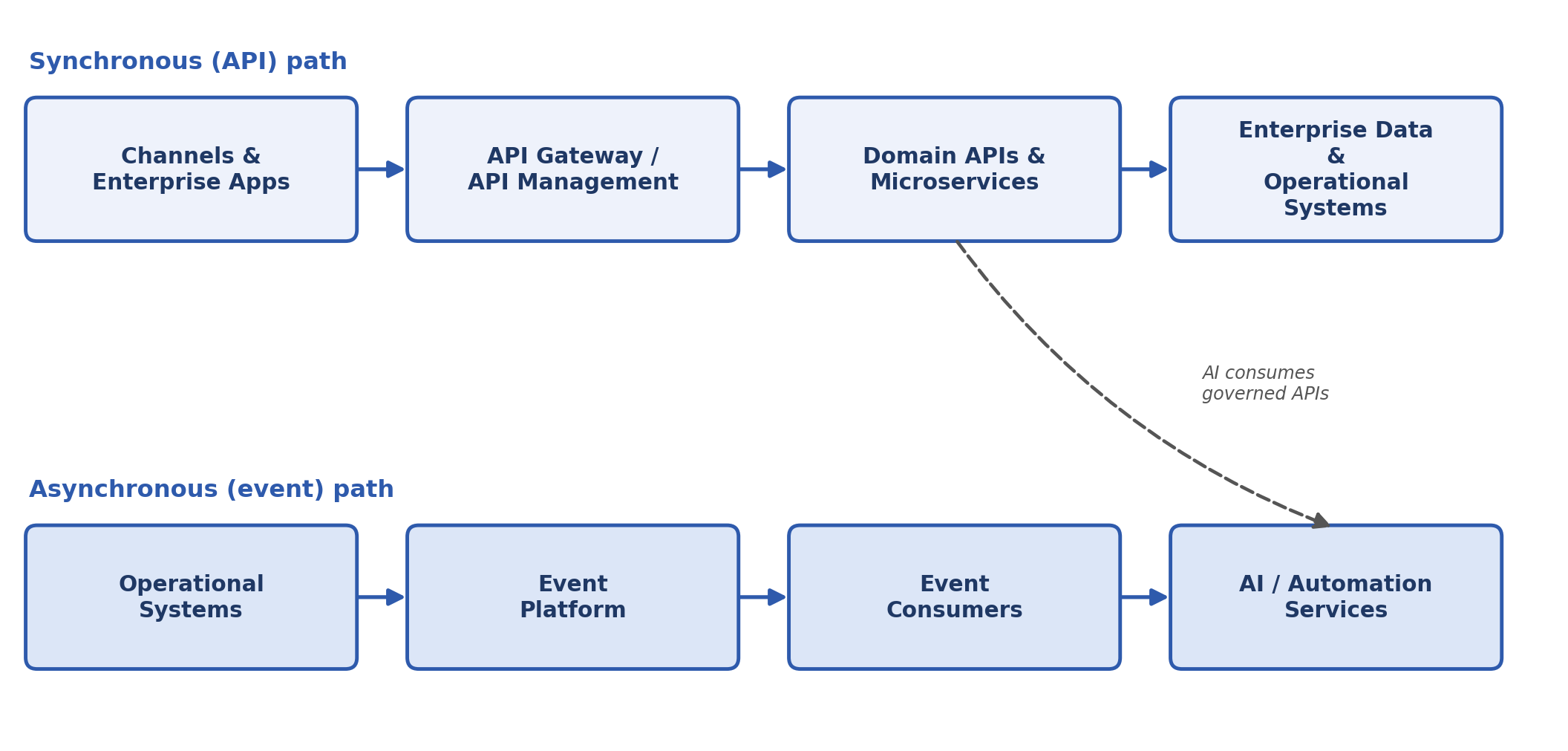
Figure 2. Synchronous API calls and asynchronous events both feed AI and automation services.
AI services then interact with both governed APIs and trusted information sources — giving APIs, events, data, and AI complementary roles. APIs expose capabilities. Events communicate change. Data platforms provide context and history. AI interprets information and generates predictions, recommendations, or decisions. Automation converts those insights into controlled actions.
Designed together, AI becomes part of the enterprise architecture — not an isolated layer bolted onto existing applications.
Governed Data Is the Foundation
One of the most underestimated challenges in enterprise AI is data consistency. Large organizations frequently have multiple representations of the same business entities — a customer may exist in CRM platforms, billing systems, transaction platforms, digital applications, analytics environments, and third-party systems. The same challenge shows up for products, suppliers, employees, locations, securities, healthcare providers, and more.
AI applications consuming information across these systems need reliable answers to basic questions:
- Which customer record is authoritative?
- Which product classification is correct?
- Which identifier connects records across systems?
- How recently was the information updated?
- Where did the information originate?
Without those answers, AI systems inherit contradictory context — which is exactly why data governance, master data management, reference data management, metadata, lineage, and data-quality controls matter more, not less, in AI architectures. The goal isn’t necessarily to centralize every piece of enterprise data into one platform; in most distributed architectures, that’s unrealistic. Instead, establish trusted data domains and clear ownership — an authoritative source, a data owner, validation rules, identifiers, quality expectations, and lineage for every critical entity — so AI services consume information through governed interfaces rather than reconciling conflicting systems on their own.
Event-Driven Architecture Brings AI Closer to Real Time
Many enterprise AI use cases become significantly more valuable when they can respond to business events as they happen: a transaction completing, a customer profile updating, an application being submitted, a payment failing, a security event, an order changing status, a new document becoming available. In a traditional batch architecture, those changes can take hours to reach downstream analytical or AI systems. Event-driven architectures shrink that gap: a business service publishes an event when something meaningful happens, it enters a messaging or streaming platform, and multiple consumers — fraud detection, analytics, notification, compliance, AI services — process it independently.
For example: a transaction service publishes a TransactionCompleted event to a streaming platform. An AI service evaluates it alongside historical or contextual information and generates a recommendation or risk score — itself published as a RiskAssessmentCompleted event, triggering the appropriate downstream workflow.

Figure 3. A transaction event triggering AI risk evaluation and a downstream workflow.
This pattern separates operational systems from AI processing while letting intelligence participate in near-real-time business processes.
Reliability Matters More When AI Takes Action
Distributed architectures introduce failure scenarios architects must explicitly design for: networks fail, services become unavailable, messages get delivered more than once, requests time out, dependencies slow down. AI services add another layer of uncertainty — inference can be slower, external model providers can become unavailable, and responses don’t always satisfy application expectations. That means resilience patterns around AI services matter just as much as they do around any other distributed system: timeouts, retries with sensible limits, circuit breakers, bulkheads, idempotency, dead-letter queues, fallback mechanisms, asynchronous processing.
Idempotency deserves special attention in event-driven automation — if an AI system decides a workflow should trigger a business action, and the same event is delivered twice, the architecture must prevent that action from firing twice. The same logic extends to distributed transactions: instead of one large transaction spanning multiple services, patterns like SAGA coordinate a sequence of local transactions with compensating actions when something fails. These patterns only get more valuable as AI takes on multi-step enterprise workflows.
Securing AI Through APIs
Security boundaries that were manageable in traditional applications get more complicated once AI agents and intelligent automation can invoke enterprise capabilities dynamically. An AI system should never automatically inherit broad access just because the user interacting with it has that access — every action deserves its own evaluation through appropriate security controls, enforced by API gateways and service layers before AI services can retrieve information or execute actions.
Four principles are worth building around:
Least-privilege access. AI services should receive only the permissions their function requires.
Separate read from high-impact actions. Retrieving a balance and transferring funds are fundamentally different risk categories.
Maintain auditability. Know which identity initiated an AI interaction, which services were called, what data was accessed, and what actions were executed.
Filter before it reaches the model. Sensitive information shouldn’t reach models that don’t need it.
APIs are the natural enforcement point for all four.
Observability Becomes Part of AI Governance
Traditional observability focuses on metrics, logs, traces, latency, errors, and infrastructure health. AI adds a new layer of questions: which model handled the request? Which version? Which enterprise services supplied context? What data was retrieved? How long did each step take? Did the AI invoke another service? What business action followed? Answering those questions requires end-to-end observability, and distributed tracing becomes particularly valuable: a single correlation identifier can follow an interaction across every hop, so architects can reconstruct the complete lifecycle of an AI-enabled transaction.

Figure 4. A single correlation ID traces the full lifecycle of an AI-enabled request.
Observability, in other words, isn’t just an operations capability anymore. In intelligent enterprise systems, it’s part of governance and accountability.
Before you continue…
The reading list you'd build – if you had time.
The reads you'd find if you had time
Experts you can actually ask
Deep dives worth your weekend
Past conferences, ready when you are
Designing Intelligent Automation Safely
One of the most promising enterprise AI patterns is the shift from systems that generate information to systems that initiate action. Think of it as three maturity levels: at the first, AI provides information — a user asks, the system answers. At the second, AI provides recommendations — it analyzes enterprise information and suggests an action, but a person approves it. At the third, AI participates in automated workflows — detecting an event, evaluating context, making a decision, invoking enterprise APIs, and triggering downstream processes.
A useful pattern:
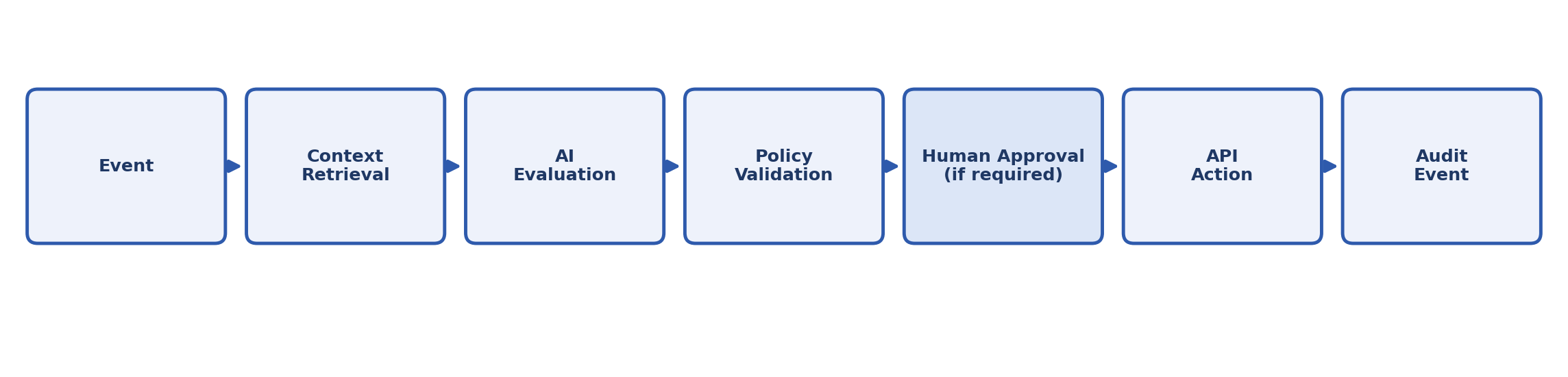
Figure 5. A governed pattern for AI-initiated automation.
That policy-validation step is critical. AI shouldn’t necessarily be the final authority for high-impact business decisions — deterministic business rules, authorization policies, and human approval remain essential controls around probabilistic AI capabilities. That’s how organizations capture the benefits of intelligent automation without giving up established governance boundaries.
Avoid Building a Parallel Architecture for AI
One of the most common architectural mistakes: standing up a separate integration ecosystem just for AI — direct database connections, duplicate datasets, AI-specific interfaces, bypassing existing enterprise services in the name of moving fast. It accelerates prototypes and creates long-term complexity in equal measure. AI initiatives should leverage and strengthen the enterprise architecture that already exists. If there’s an API platform, AI should consume governed APIs. If there’s an event platform, AI should participate through established event patterns. If trusted data domains exist, AI should consume those authoritative sources. If centralized identity and access management exists, AI services should integrate with it. The goal is to evolve the enterprise architecture — not build an isolated one beside it.
A Practical Reference Architecture
A trusted AI ecosystem can be viewed as several interconnected layers:
Experience Layer. Web applications, mobile applications, enterprise portals, conversational interfaces, and developer experiences.
API and Integration Layer. API gateways, domain APIs, microservices, orchestration services, and integration capabilities.
Event Layer. Streaming platforms, messaging infrastructure, event schemas, and event consumers.
Trusted Data Layer. Operational databases, master and reference data, analytical platforms, metadata, data quality, and lineage.
AI and Intelligence Layer. Machine learning models, large language models, retrieval services, inference platforms, AI agents, and intelligent automation.
Governance and Security Layer. Identity, authorization, API policies, model governance, data governance, auditability, privacy controls, and compliance.
Observability and Reliability Layer. Metrics, logging, distributed tracing, resilience patterns, monitoring, incident management, and service-level objectives.
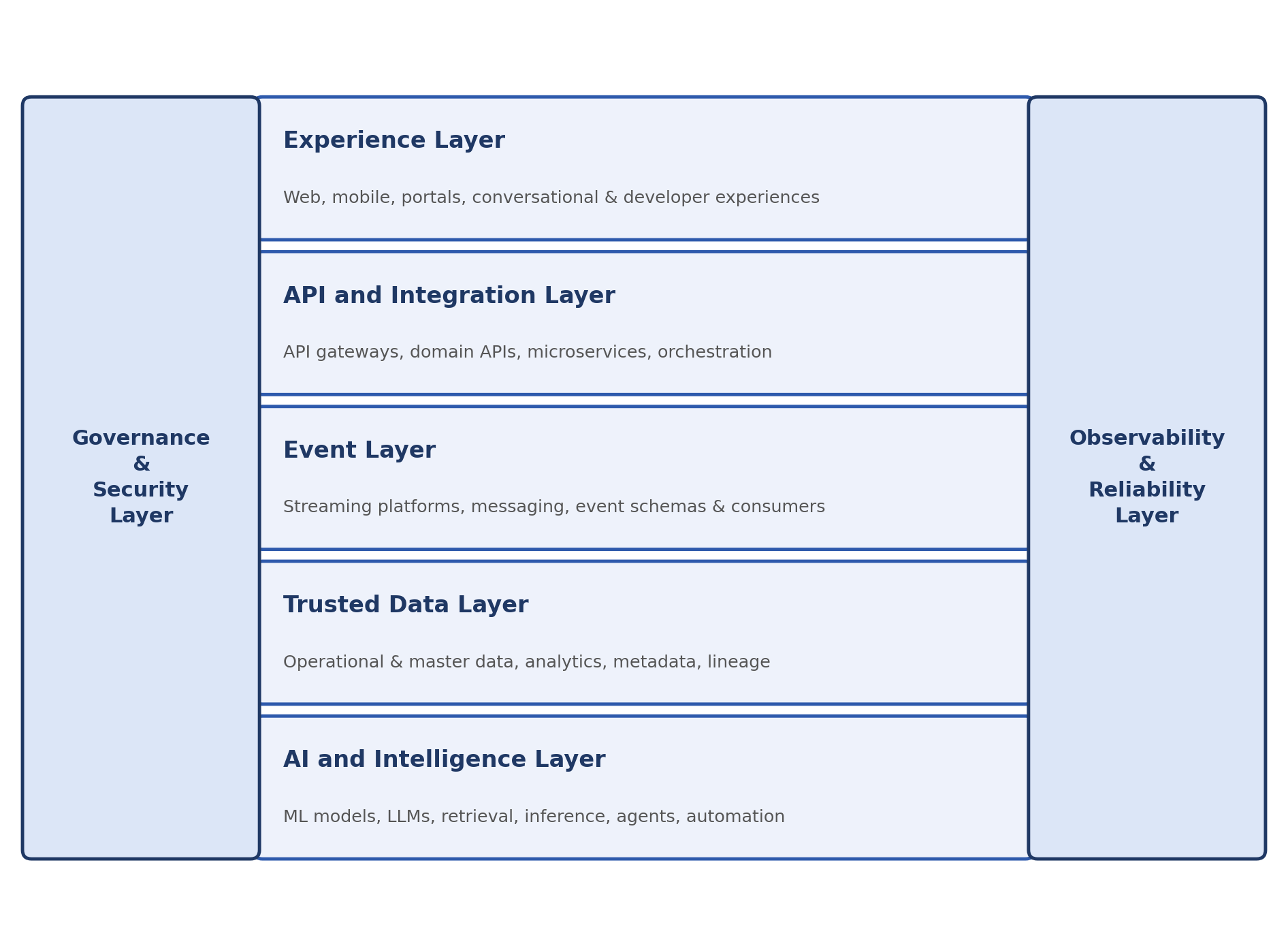
Figure 6. Governance and observability cut across every layer of the stack.
These layers shouldn’t operate independently — the architecture becomes powerful once trust can propagate across them. A trusted identity invokes a governed API. The API retrieves authoritative information. Events communicate state changes. AI evaluates trusted context. Policies determine what actions are permitted. Observability records the complete interaction. That is the foundation of a trustworthy intelligent enterprise.
Lessons from Large-Scale Enterprise Transformation
Large transformation programs across financial services, healthcare, retail, and other enterprise environments keep surfacing the same architectural challenges: legacy systems rarely disappear quickly, data stays distributed, business processes span multiple applications, teams modernize at different speeds, and security and regulatory requirements can’t simply be redesigned around the latest technology. Successful architecture depends less on replacing everything and more on establishing stable boundaries between systems. APIs create boundaries for capabilities. Events create boundaries for state changes. Governed data establishes authoritative business context. Cloud-native services provide scalable execution environments. AI adds intelligence across all of it. Combine these deliberately, and organizations can modernize incrementally while preserving reliability and governance.
Before you continue…
The reading list you'd build – if you had time.
The reads you'd find if you had time
Experts you can actually ask
Deep dives worth your weekend
Past conferences, ready when you are
Five Principles for Architects Building Trusted AI
The five principles, at a glance
- Treat enterprise APIs as products, not integration plumbing. Define clear contracts, ownership, security policies, service-level objectives, and lifecycle management.
- Establish trusted data before scaling AI. Identify authoritative data sources, improve data quality, maintain lineage, and standardize critical business entities.
- Combine APIs and events. Use APIs for controlled capability invocation and events for asynchronous communication and real-time business signals.
- Put deterministic controls around probabilistic systems. Authorization, policy validation, business rules, and approval workflows should govern high-impact AI actions.
- Design for observability from the beginning. AI-enabled transactions should be traceable across models, APIs, data sources, events, and downstream actions.
From Connected Enterprise to Intelligent Enterprise
Enterprise architecture has evolved through several generations — from tightly coupled applications to service-oriented architectures, then toward APIs, microservices, cloud platforms, and event-driven systems. AI is the next major evolution, but it doesn’t replace those foundations. It depends on them. The organizations that successfully scale AI won’t necessarily be the ones deploying the largest number of models. They’ll be the ones building architectures that deliver trusted information and controlled enterprise capabilities to AI systems, consistently.
APIs provide access. Trusted data provides context. Events provide real-time awareness. AI provides intelligence.
Around all four, security, governance, resilience, and observability provide trust. When these capabilities work together, organizations move beyond isolated AI experiments toward intelligent automation embedded throughout the enterprise. That’s the real architectural opportunity: not simply adding AI to existing applications, but evolving enterprise architecture so that APIs, trusted data, events, and intelligence operate together — securely, reliably, and at scale.
Author
🔍 Frequently Asked Questions (FAQ)
1. What is a trusted AI architecture?
A trusted AI architecture is an enterprise architecture in which trust is established across the information, services, interfaces, and interactions surrounding AI systems. Reliable AI depends not only on the model, but also on trusted data, secure integrations, governance, resilience, and observability.
2. Why are APIs important for trusted enterprise AI?
APIs provide a governed interface between AI systems and enterprise capabilities. They can enforce authentication, authorization, validation, data filtering, rate limiting, audit logging, policy controls, and observability without requiring AI systems to access underlying databases or applications directly.
3. How do API-driven architectures support AI systems?
API-driven architectures expose stable business capabilities that AI applications and agents can consume through defined contracts. This abstracts underlying systems while allowing organizations to modernize databases, applications, and legacy platforms without continually redesigning their AI integrations.
4. Why is data governance important for enterprise AI?
Enterprise AI often consumes information from multiple systems that may represent the same customer, product, transaction, or other business entity differently. Data governance establishes authoritative sources, ownership, identifiers, validation rules, quality expectations, metadata, and lineage so AI systems can operate on trusted context.
5. Should enterprises build a separate architecture specifically for AI
The article recommends evolving existing enterprise architecture rather than creating a parallel integration ecosystem for AI. AI services should use established API platforms, event infrastructure, trusted data domains, identity systems, security controls, and governance mechanisms whenever those capabilities already exist.